Secure your adventure on the Inca Trail 2027. Book today and choose the perfect date for you.
We have 100% guaranteed daily availability for all Machu Picchu tours, including the circuit 3B. Book now!
Hiking the Inca Trail to Machu Picchu is one of the most amazing and transformative experiences you can have in the Peruvian Andes. This legendary route was used in the 15th century by the Incas—especially by the nobility and the emperor himself—as a royal road to the sacred city of Machu Picchu.
Along the way, from the ancient Inca city of Ollantaytambo to Machu Picchu, you can appreciate impressive archaeological remains that demonstrate the profound architectural and spiritual knowledge of the Incas. These sacred sites reveal the logic, symbolism, and mysticism that permeated every section of the Qhapaq Ñan, or Great Royal Road.
The Inca Trail was designed for ceremonial and religious purposes. It was a path reserved for rituals connecting with the Apus —the mountain spirits— and along the way, offerings and ceremonies were performed in honor of sacred peaks such as Mount Veronica or Wakaywilka, considered spiritual guardians of the trail. Today, walking this ancient route is much more than a trekking adventure: it's an opportunity to connect with the Andean worldview, the Inca legacy, and the unique energy of the Andes.
Highlights
-
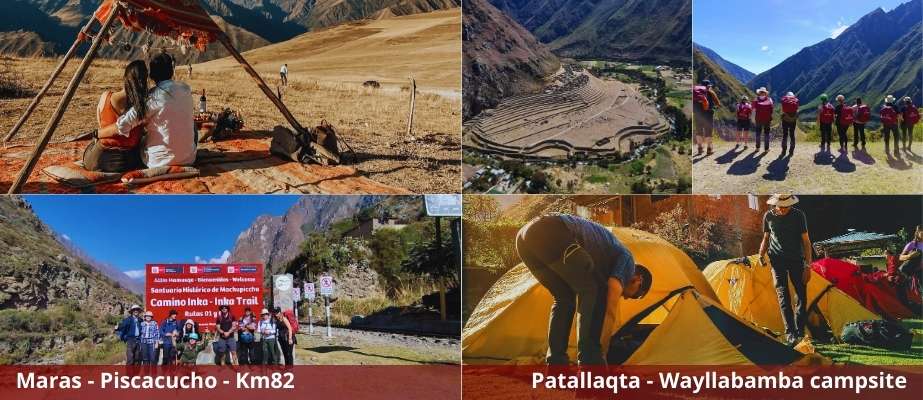
Hotel pick-up begins between approximately 5:00 a.m. and 5:30 a.m. We will depart for the village of Maras, arriving around 6:30 a.m., just in time to enjoy the morning tranquility and the first rays of sunlight on the Andean landscapes.
In Maras, you will discover not only spectacular Andean landscapes and ancient salt mines, but also the warmth and wisdom of its people. We will begin the day with an authentic experience, sharing a delicious traditional breakfast with our local porters.
This special moment is an opportunity to get to know the people who make every adventure in the Andes possible. Around a simple table, yet full of flavor and tradition, you can sample local products while listening to life stories, mountain anecdotes, and customs passed down through generations.
More than just a meal, this breakfast is an act of gratitude and human connection. A space to appreciate the work of the porters, who embody the strength, humility, and solidarity of the Andean communities.
After our visit to Maras, we will continue our journey to Piscacucho, also known as Kilometer 82, the starting point of the legendary Classic Inca Trail.
Around 10:00 a.m., we will arrive at this first official checkpoint, where our trek to Machu Picchu will begin. Here, you will need to present the following required documents:
Inca Trail entrance ticket
Original passport (valid)
International student ID (if applicable and valid), if you have a discounted rate
Once the checkpoint is complete, we'll prepare to begin this unforgettable journey along one of the world's most iconic trails.
We'll start our hike at kilometer 82, at an altitude of 2,720 m (8,923 ft). From this point, we'll cross the Vilcanota River and follow its course to the right, entering the historic Inca Trail.
The first day is considered an acclimatization stage, as the hike takes place on relatively flat and accessible terrain, allowing the body to adjust and fully enjoy the natural and archaeological surroundings.
During the trek, we'll witness truly spectacular landscapes:
The Huillca Raccay viewpoint.
The vast and impressive archaeological complex of Llactapata (also known as Patallacta), which dominates the valley with its terraced design.
The breathtaking views of the snow-capped peak of W'akay Willka (5,860 m / 19,225 ft), better known as Mount Veronica, considered sacred by local communities.
Our first campsite will be in Wayllabamba (3,000 m / 9,842 ft), a lush valley surrounded by Andean vegetation. Nighttime temperatures in this area can drop to 5°C, depending on the season.
In Wayllbamba, a natural, tranquil, and majestic setting, we prepare to enjoy a comforting lunch and recharge our energy. You'll experience an authentic and refreshing activity: preparing traditional mango ceviche, a local recipe that blends native ingredients with the creativity of the farming communities.
You'll be an active participant in its preparation. You'll be welcomed with a brief explanation of the dish's history. Mango ceviche, unlike classic fish ceviche, uses fresh, ripe mangoes grown in lower-lying areas and brought to this community, where they are combined with red onion, yellow chili pepper (ají amarillo or limo), freshly squeezed lime juice, Maras salt, and a touch of herbs like huacatay or Andean mint.
During the preparation:
You'll learn to peel and cut the mango at the perfect point of ripeness.
You'll discover the secrets of Andean seasoning, balancing acidity, spiciness, and sweetness.
You'll hear stories and customs related to the use of mangoes in special celebrations or harvest time.
At the end, you'll share ceviche, accompanied by toasted corn kernels, herbal teas, or local chicha. More than a cooking class, it's a profound connection with the flavors, knowledge, and hospitality of Andean culture.
-
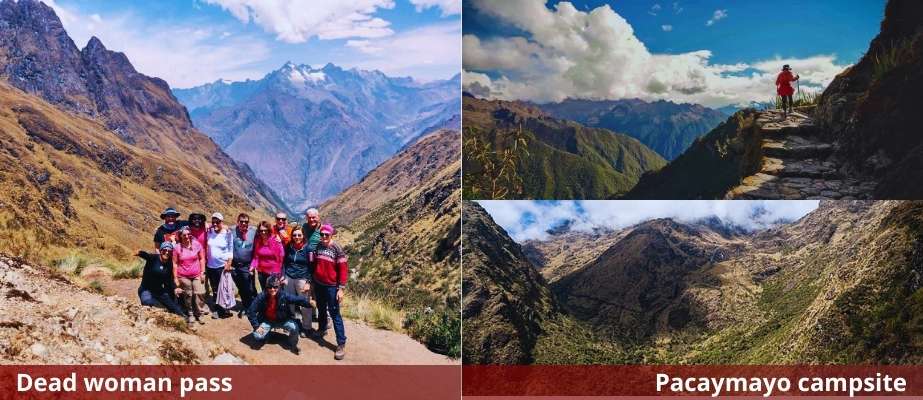
After waking up around 5:30 a.m. and enjoying a hot and nutritious breakfast, we'll begin one of the most challenging yet rewarding days of the Inca Trail: the ascent to Warmihuañusca Pass, also known as the famous "Dead Woman's Pass", located at an altitude of 4,215 m (13,829 ft). The climb is steep and demanding, but each step brings us closer to one of the most memorable moments of the trek. Upon reaching the summit, you'll feel a profound sense of accomplishment and connection with the mountains, surrounded by breathtaking landscapes and Andean energy.
Warmihuañusca is not only the highest point on the Inca Trail but also a place imbued with deep symbolism in the Andean worldview. According to ancestral beliefs, this mountain represents the threshold between the earthly and spiritual worlds. Upon reaching its summit, it is believed that hikers cross a transitional space, a "Pachakuti," or moment of inner transformation.
The name “Warmiwañusca” (the dead woman) evokes the silhouette of a reclining woman visible in the mountain's profile. For the Andean peoples, the mountains, or apus, are protective spirits, and this female figure can be interpreted as a guardian who watches over and accompanies us on our journey. Climbing this pass also implies a deep connection with oneself, an act of respect for nature and its sacred forces. At this point, we will leave our apachetas (stone cairns).
According to the Andean worldview, placing a stone on the apacheta is a gesture of respect and gratitude to the apus (mountain spirits) and Pachamama (Mother Earth). By doing so, hikers ask for protection, strength to continue their journey, or leave a symbolic thought for those who have passed on. It is also a way to integrate into the journey, to "leave a mark" without harming, offering instead of taking.
After a well-deserved rest at the summit, we will begin the descent to the Pacaymayo Valley (3,600 m / 11,811 ft), where we will stop for a hearty lunch and regain our energy amidst a tranquil and majestic natural environment.
After lunch, we will begin the second steep two-hour climb to Runkuraqay Pass (3,750 m / 12,303 ft). We will arrive at our campsite around 5 p.m. Nighttime temperatures at this campsite typically reach around 4°C.
-
This day is undoubtedly one of the most impressive and magical on the Inca Trail, so keep that in mind when you begin your hike on day three!
We'll wake up early to enjoy a hot breakfast at 6:00 a.m., and then begin a gradual ascent to the first archaeological site of the day: Runkurakay (whose name means "ovoid place" due to the semicircular shape of its structure). This site, which likely functioned as a tambo or ceremonial resting place, is located at 3,750 m (12,303 ft), marking the third highest point on the Inca Trail.
From there, we'll continue our trek through diverse Andean ecosystems until we reach Sayacmarca, which means "Dominant Town." This ancient citadel and ceremonial center is strategically built on a rocky hill, about 20 km from the start of the trail. From this point, you'll enjoy breathtaking panoramic views of mountains, canyons, and a landscape that blends the natural with the sacred. From Sayacmarca, we'll continue to one of the most magical places on the trek: the Inca archaeological site of Phuyupatamarca, whose name means "City in the Clouds." This ceremonial complex is just a short walk from the third mountain pass and offers one of the most sublime views on the Inca Trail, literally suspended above the clouds. After exploring this fascinating site, we'll begin a long descent down more than 3,000 stone steps that wind through the cloud forest. Along the way, we'll reach Intipata, a beautiful and extensive set of Inca agricultural terraces with spectacular views of the Urubamba River valley. Here we'll pause to rest, explore, and take photos.
Then, we'll resume our trek to our third campsite at Wiñayhuayna ("Forever Young"), located at 2,680 m (8,792 ft). Today's trek will take between 7 and 8 hours, but we'll arrive back at camp in time for lunch, which is unusual compared to the previous days. Just a short walk from camp is the impressive archaeological site of Wiñayhuayna, considered by many to be the most beautiful on the Inca Trail. Even if you're tired after the hike, you can't miss visiting this place, where the architecture, ceremonial fountains, and terraces blend harmoniously with the jungle landscape. It's the perfect way to end this unforgettable day.
Nighttime temperatures in Wiñayhuayna usually hover around 12°C (54°F), much milder compared to the previous nights.
-
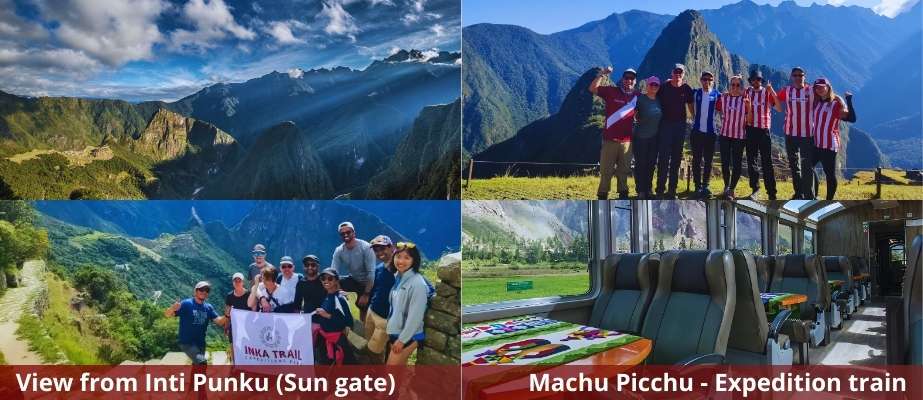
On our last day of the Inca Trail, we'll wake up very early, between 2:00 am and 4:00 am, depending on the campsite location. A boxed breakfast will be provided. At approximately 6:30 am, we'll arrive at the much-anticipated Sun Gate. Here, the majestic Citadel of Machu Picchu unfolds before us, revealing its breathtaking beauty—an incredible sight for everyone! It's an extraordinary moment to imagine what the Incas must have experienced during their arduous journey to this expansive temple of Machu Picchu. From the Sun Gate, we'll descend into the citadel of Machu Picchu.
The first part we'll visit is Circuit 1B, or the upper terraces, where your guide will give a brief explanation of the site, and you'll have a great opportunity to take a classic photo at one of the seven wonders of Machu Picchu. From there, we'll descend to the checkpoint where we'll register and leave our belongings (optional, extra cost for lockers). We'll then re-enter (with a second entrance ticket) the Machu Picchu citadel (entering circuit 2A, 2B, or 3B, depending on availability). Accompanied by your professional guide, you'll explore the main archaeological areas of Machu Picchu. Here, you'll have the opportunity to visit the Temple of the Sun, as well as the Sacred Plaza, the Royal Tomb, and the Main Plaza. Machu Picchu is considered the spiritual center, the center of esoteric wisdom in the world. Once the guided tour is over, you'll have free time to explore the site at your own pace.
Return to Cusco: After your visit to Machu Picchu, we'll descend by bus to the town of Aguas Calientes, where we'll board the Expedition train back to the Ollantaytambo or Poroy train station. Please note that the train departure time may vary depending on the schedule and train availability. Once you arrive at the train station, our transportation will be waiting to meet you and transfer you back to your hotel in Cusco.
NOTE: PLEASE CHECK THE AVAILABILITY OF ENTRANCE TOURS WITHIN THE MACHU PICCHU CITADEL WITH YOUR SALES REPRESENTATIVE.
End of our Services
For availability of spaces for this service, please contact us info@salkantaytrek.org or by WhatsApp (+51) 970 506 205 and we`ll send you detailed information, prices, terms and conditions.
Please keep in mind that significant price reductions are available for groups. All our tours are fully guaranteed, departure every day. Contact us for more information for the tour that you are choosing, or to begin customizing your own itinerary. recommendations:
"Inka Trail Expeditions Perú is a tour operator travel agency in Peru and the city of Cusco, We really know what we do and offer, We are well managed, with several offices in Peru and a long list of travel destinations, offering all travel alternatives in Perú, from family trips, honeymoon trips and luxury travel, including adventure tours and exploring trips to the jungle, for almost any budget”
NOTE: Inka Trail Expeditions Perú, specializes in organizing the ideal travel plan to Peru, with hotels and destinations that you choose, because we have all confidential and promotional rates. For guidance on how to organize your custom package. Please write us.

Get a 5% discount on all our tours if you book before October 31st, 2026


 5/5 stars
Capitan Percy was the Inca emperor of guides during my Salkantay trek of 5 days. I really enjoyed this unique experience, thanks to his patience, compassion, comradery and great energy! I learned a lot about the Cusquean nature, culture and history. I also enjoyed the passion he shared for the...
5/5 stars
Unbelievable experience! Yisus was an incredible tour guide that explained everything to us clearly. Sebastian could be a Michelin chef the way he was feeding us, and Genaro always ensured our belongings got to our camp before us and safely....
5/5 stars
The guides Percy, Iza and Frank contributed to making this unique experience of knowledge, discovery and personal growth unforgettable; besides being knowledgeable, the love for their origins shines in their eyes and they transmitted it to us very well. Thanks to all three of them who supported us...